
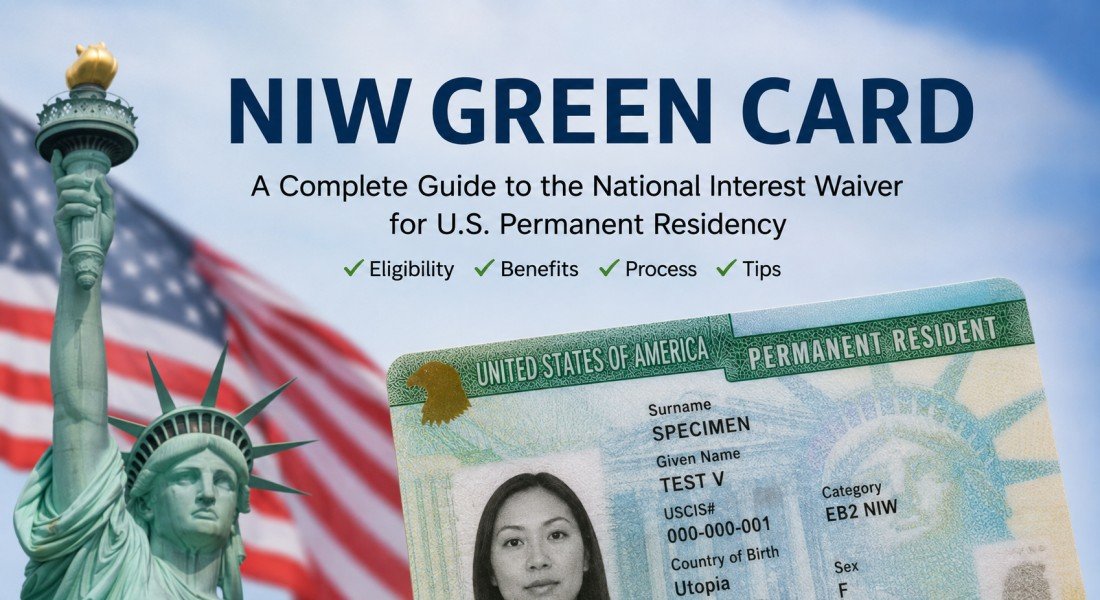
What Is an NIW Green Card?
For highly educated professionals, researchers, entrepreneurs, and individuals with exceptional ability, obtaining U.S. permanent residence can sometimes involve a lengthy employer-sponsored process. The NIW green card, formally known as the EB-2 National Interest Waiver pathway, offers another option for qualified applicants whose proposed work can benefit the United States.
A National Interest Waiver allows certain EB-2 applicants to request that the usual job-offer and labor-certification requirements be waived. Unlike many employment-based immigration routes, an eligible applicant can generally file an NIW petition independently rather than relying on a specific U.S. employer.
According to the USCIS Policy Manual, an applicant must first qualify for the underlying EB-2 classification and then demonstrate that granting the waiver is justified in the national interest.
This makes the NIW green card an attractive option, but it is not an automatic pathway to permanent residence. USCIS evaluates each petition individually and considers the evidence as a whole.
Who Can Qualify for an NIW Green Card?
The first step is establishing eligibility for the EB-2 immigrant classification. Generally, an applicant must qualify either as a professional holding an advanced degree or as a person of exceptional ability in the sciences, arts, or business.
Advanced Degree Professionals
An applicant may qualify through an advanced degree such as a master’s degree, doctorate, or another qualifying credential. In certain circumstances, a bachelor’s degree combined with progressive post-degree experience may satisfy the applicable standard.
However, having an advanced degree alone does not mean that an applicant automatically qualifies for a National Interest Waiver. The applicant must separately establish why the proposed endeavor deserves the waiver.
Individuals With Exceptional Ability
Applicants without a qualifying advanced degree may potentially qualify through exceptional ability. USCIS regulations provide several types of evidence that can be considered, including academic records, professional experience, licenses, remuneration, memberships in professional associations, and recognition for achievements or significant contributions.
USCIS evaluates the evidence under the applicable regulatory requirements rather than relying on a person’s job title alone.
The Three NIW Requirements
The most important part of an NIW green card petition is satisfying the three-part framework established in Matter of Dhanasar. USCIS continues to use this framework when evaluating National Interest Waiver requests.
1. The Proposed Endeavor Must Have Substantial Merit and National Importance
The first requirement focuses on the applicant’s specific proposed endeavor in the United States.
Simply saying that you plan to work as an engineer, doctor, researcher, business owner, or technology professional may not be enough. The petition should explain what you actually intend to accomplish and why that work matters.
USCIS may consider endeavors involving areas such as:
- Science and research
- Technology and innovation
- Healthcare
- Education
- Business and entrepreneurship
- Engineering
- Economic development
- Other fields with meaningful societal or economic value
Importantly, national importance is not determined solely by whether the applicant intends to work throughout the entire country. USCIS focuses on the potential prospective impact of the specific endeavor.
For example, an entrepreneur may present a plan to develop technology that addresses an important industry problem, while a researcher might demonstrate how proposed work could contribute to a significant scientific field.
2. The Applicant Must Be Well Positioned to Advance the Endeavor
The second prong turns attention to the applicant.
USCIS may consider education, specialized knowledge, skills, previous achievements, professional record, business plans, research, publications, investments, customer interest, contracts, or other evidence demonstrating the applicant’s ability to move the proposed endeavor forward.
A strong petition therefore connects past achievements with future plans.
For instance, if someone has developed successful technologies, published influential research, obtained relevant patents, or built a successful business, those accomplishments may help demonstrate that the person has the background necessary to advance a related endeavor in the United States.
The goal is not simply to show that the applicant is talented. The evidence should explain why that particular individual is realistically positioned to make progress on the proposed work.
3. Waiving the Job Offer Must Benefit the United States
The third prong asks whether, on balance, the United States would benefit from waiving the normal job-offer and labor-certification requirements.
This part recognizes that some individuals may provide valuable contributions even when their immigration case does not fit neatly into a traditional employer-sponsored structure.
USCIS may consider factors such as whether obtaining a labor certification would be impractical, whether the applicant’s contributions would benefit the country even if qualified U.S. workers are available, and whether the nature of the proposed work makes a waiver beneficial.
Meeting the first two requirements does not automatically guarantee approval. The applicant must establish the complete case under all three prongs.
What Evidence Can Support an NIW Petition?
A successful NIW green card petition is usually built around detailed, credible evidence. The exact documentation depends on the applicant’s background and proposed endeavor.
Potential evidence can include:
- Academic degrees and transcripts
- Professional licenses and certifications
- Resume or curriculum vitae
- Employment records
- Published research or professional articles
- Citations to scholarly work
- Patents and intellectual property
- Awards and professional recognition
- Evidence of business success
- Expert recommendation letters
- Contracts or letters from prospective customers
- Investment or funding documentation
- Business plans
- Evidence of industry impact
- Media coverage of professional achievements
- Documentation showing progress toward the proposed endeavor
USCIS emphasizes that there is no single document that guarantees eligibility. Officers review the totality of the evidence when determining whether an applicant meets the applicable requirements.
Why Is the NIW Green Card Attractive?
One of the biggest advantages of the NIW route is flexibility.
No Specific Employer Sponsorship
An approved NIW petition does not depend on a traditional employer-sponsored job offer in the same way as many other EB-2 cases. USCIS explains that a person requesting a National Interest Waiver may self-petition.
This can be particularly useful for entrepreneurs, researchers, independent professionals, and others whose career plans may involve multiple projects or organizations.
Labor Certification Can Be Waived
The National Interest Waiver can also waive the permanent labor-certification requirement. This removes a major step associated with conventional employer-sponsored EB-2 cases.
Greater Career Flexibility
Because the petition is based on the applicant and proposed endeavor rather than solely on one sponsoring employer, the NIW structure can provide greater flexibility for qualified professionals.
That said, applicants should understand the difference between having an approved NIW petition and actually becoming a U.S. permanent resident. Visa availability and the remaining green card process still matter.
How Does the NIW Green Card Process Work?
Although individual cases differ, the process generally involves several stages.
Step 1: Determine EB-2 Eligibility
First, the applicant needs to establish that they qualify for EB-2 classification through an advanced degree or exceptional ability.
Step 2: Develop the Proposed Endeavor
The petition should clearly explain what the applicant plans to do in the United States. A vague career objective is generally less persuasive than a specific, well-supported plan.
Step 3: Build the Evidence
Applicants should gather documentation supporting their education, professional achievements, expertise, proposed work, and potential impact.
Step 4: Prepare the NIW Petition
The applicant or their representative prepares the appropriate immigration filing and supporting documentation. USCIS has confirmed that eligible NIW applicants may self-petition using Form I-140, Immigrant Petition for Alien Workers.
Step 5: USCIS Review
USCIS reviews the petition and evidence. Depending on the circumstances, USCIS may approve the petition, issue a request for additional evidence, or deny the case.
Step 6: Complete the Green Card Stage
An approved I-140 is not necessarily the final step. Depending on the applicant’s circumstances and visa availability, the person may need to complete adjustment of status in the United States or consular processing abroad.
Common NIW Mistakes to Avoid
A well-prepared petition should avoid several common weaknesses.
Using a generic career description: Saying that you want to continue working in your profession does not fully explain the proposed endeavor.
Focusing only on qualifications: Degrees and experience are important, but the petition must also address the National Interest Waiver criteria.
Making unsupported claims: Statements about future economic or scientific impact should be supported with credible documentation.
Submitting disconnected evidence: Strong documents become more useful when they tell a consistent story about the applicant’s past work, current expertise, and future plans.
Assuming approval is automatic: Even highly accomplished professionals must satisfy the applicable legal requirements. USCIS describes NIW decisions as discretionary and case-specific.
NIW Green Card vs. Traditional EB-2
The biggest distinction is the job-offer requirement.
A conventional EB-2 case generally involves a U.S. employer and, in many situations, labor certification. An NIW applicant can request a waiver of those requirements when the evidence establishes that the waiver is in the national interest.
This distinction can make NIW particularly appealing to individuals pursuing independent research, entrepreneurship, specialized professional projects, or other endeavors that do not fit a conventional employer-sponsored model.
The Importance of a Clear Personal Story
A strong NIW petition should not feel like a collection of certificates and recommendation letters. The evidence should create a clear connection between the applicant’s background and future plans.
A useful structure is:
Past: What has the applicant accomplished?
Present: What expertise or work is the applicant currently pursuing?
Future: What specific endeavor will the applicant undertake in the United States?
Impact: Why could that endeavor matter beyond the applicant’s own career?
Waiver: Why would the United States benefit from allowing the applicant to pursue that endeavor without the ordinary job-offer and labor-certification requirements?
This approach can make the petition easier to understand and helps organize the evidence around the actual legal framework.
Where Can Applicants Find Reliable Information?
Immigration rules and procedures can change, so applicants should rely on current government guidance rather than outdated blog posts or social media discussions.
The USCIS Policy Manual guidance on EB-2 and National Interest Waivers is an important starting point for understanding the current framework. USCIS explains the EB-2 classification, National Interest Waiver requirements, evidence considerations, and the three-prong analysis.
Applicants who are researching professional services and online visibility can also explore Ads Place’s link building services for information about digital outreach and authority-building strategies.
Frequently Asked Questions About the NIW Green Card
Can I apply for an NIW without a U.S. employer?
Potentially, yes. USCIS states that an NIW petitioner may self-petition, meaning a qualifying applicant does not need a sponsoring employer for the NIW petition itself.
Does having a master’s or doctoral degree guarantee an NIW?
No. An advanced degree can help satisfy the underlying EB-2 classification, but the applicant must also establish the three National Interest Waiver requirements.
Do entrepreneurs qualify for an NIW?
Entrepreneurs can potentially qualify when they meet the EB-2 requirements and demonstrate that their specific proposed endeavor satisfies the NIW framework. USCIS provides guidance concerning entrepreneurs as part of its NIW analysis.
Is an NIW the same as a green card?
The NIW is an immigration classification and waiver pathway within EB-2. An approved NIW I-140 does not by itself mean the applicant immediately receives a green card. The applicant must still complete the applicable immigrant visa or adjustment-of-status process when eligible.
Should I hire an immigration attorney?
An attorney is not legally required in every case, but NIW petitions can involve detailed legal and evidentiary arguments. Applicants with complicated backgrounds, unusual proposed endeavors, or questions about eligibility may benefit from qualified immigration counsel.
Final Thoughts
The NIW green card can provide an important immigration option for qualified professionals who want to contribute their expertise to the United States without relying on a traditional employer-sponsored EB-2 pathway.
The strongest cases are built around more than impressive credentials. They explain a specific proposed endeavor, demonstrate why that work has substantial merit and national importance, show that the applicant is well positioned to advance it, and establish why waiving the job-offer and labor-certification requirements would benefit the United States.
Because immigration standards and procedures can change, applicants should always review current USCIS guidance and consider professional legal advice for their individual circumstances. An informed, evidence-based approach can help applicants understand whether the NIW pathway fits their long-term U.S. immigration goals.

