
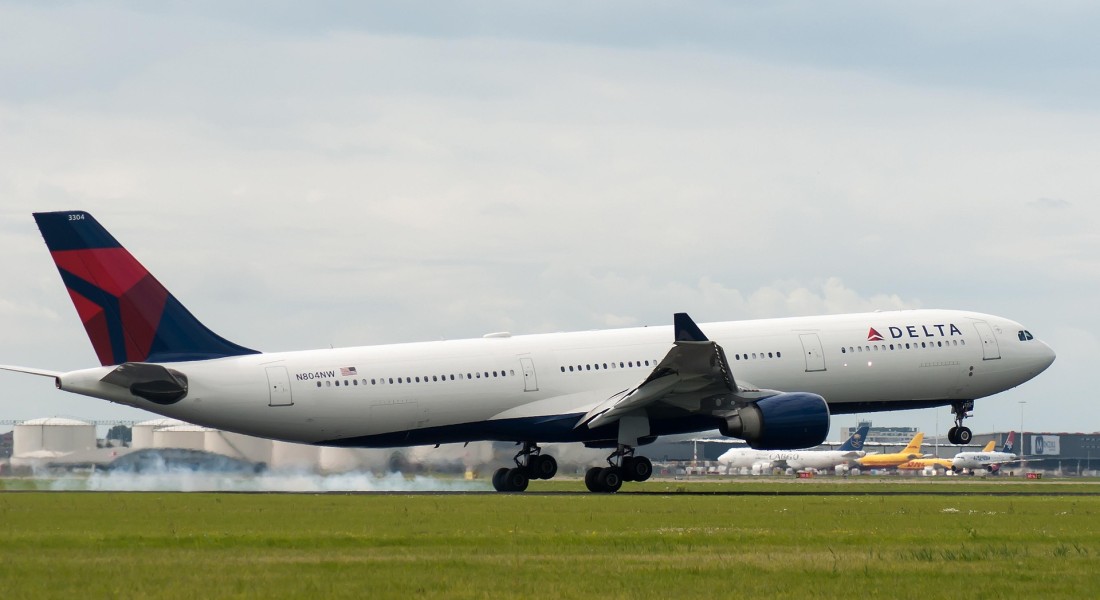
The vast, sapphire expanse of the North Pacific Ocean is one of the most remote corridors in global aviation. For passengers aboard Delta Flight DL275, a routine long-haul journey from Detroit (DTW) to Tokyo Haneda (HND), this stretch of the flight is usually a time for deep sleep, movie marathons, or gazing out at the endless horizon. However, on a recent transpacific crossing, the quiet hum of the Airbus A350 was interrupted by an operational pivot that would turn a direct flight into an transcontinental detour.
When the news broke that delta flight dl275 diverted lax, it sparked immediate curiosity among aviation enthusiasts and concern among travelers. What causes a state-of-the-art aircraft, designed for ultra-long-range efficiency, to abandon its course toward Japan and head for the Southern California coast? The story of DL275 is a masterclass in modern aviation safety, technical precision, and the “safety-first” culture that defines the industry today.
The Anatomy of the Journey: From the Midwest to the Pacific
Delta Flight 275 is a flagship route. Connecting the automotive heart of America in Detroit to the bustling metropolis of Tokyo, it serves as a critical bridge for business and tourism. The aircraft typically utilized for this 13-hour marathon is the Airbus A350-900, a marvel of carbon-fiber engineering known for its quiet cabin and advanced fuel efficiency.
On the day of the incident, the flight departed Detroit Metropolitan Wayne County Airport (DTW) on schedule. For the first several hours, the mission was nominal. The aircraft climbed to its initial cruising altitude, likely around 34,000 to 38,000 feet, following the “Great Circle” route that takes planes north toward the Arctic Circle and over the Aleutian Islands to capitalize on the Earth’s curvature.
The Turning Point: Trouble Over the North Pacific
The diversion began to unfold as the aircraft was approximately 600 nautical miles southwest of Anchorage, Alaska. At this point, the A350 is in a region often referred to by pilots as “the gap”—a place where land is far away and the environmental conditions are unforgiving.
According to technical logs and crew reports, a cautionary alert surfaced on the flight deck’s electronic centralized aircraft monitor (ECAM). The issue was identified within the engine anti-ice system of one of the Rolls-Royce Trent XWB engines.
Why the Anti-Ice System Matters
To the average passenger, “ice” seems like a winter-only problem on the ground. However, at 38,000 feet, even in the middle of summer, temperatures can plummet to -50°C (-58°F).
- Atmospheric Moisture: When an aircraft flies through clouds or moisture at high altitudes, ice can rapidly accumulate on the leading edges of the wings and, more critically, the engine inlets.
- The Risk: If ice builds up on the engine inlet, it can break off and be ingested by the engine, causing mechanical damage or a “flameout” (engine shutdown).
- The Solution: The anti-ice system uses hot “bleed air” from the engine compressor to keep these surfaces warm. If this system fails, the engine is vulnerable to the elements.
The Decision: Why Los Angeles (LAX)?
When a mechanical anomaly occurs over the ocean, the flight crew must make a high-stakes calculation. They are governed by ETOPS (Extended-range Twin-engine Operational Performance Standards). These regulations dictate exactly how far a twin-engine plane can be from a suitable landing site at any given time.
While Anchorage (ANC) was technically closer, the flight crew and Delta’s Integrated Operations Center (IOC) in Atlanta opted for Los Angeles International Airport (LAX). This decision highlights the strategic side of airline operations:
- Maintenance Capabilities: LAX is a major hub with extensive maintenance hangars and specialized technicians who are qualified to work on the Airbus A350 and its Rolls-Royce engines.
- Passenger Reaccommodation: For hundreds of passengers suddenly stranded, LAX offers vastly more options for rebooking on subsequent flights to Tokyo compared to smaller northern outposts.
- Weather and Safety: LAX provided stable weather and long runways, ensuring that if the situation deteriorated, the landing would be as controlled as possible.
Inside the Cabin: The Passenger Experience
For those on board, the diversion was signaled by a change in the aircraft’s “moving map” and a subsequent announcement from the flight deck. Reports from passengers suggest the atmosphere remained calm. The pilots communicated with transparency, explaining that while the aircraft was flying normally at that moment, a technical precaution required them to head to a land-based facility rather than continuing across the open water toward Japan.
The flight path shifted from a westward heading to a southeasterly one, tracing the coastline of British Columbia and the Pacific Northwest before descending into the hazy sunshine of Southern California.
“It’s a strange feeling to be prepared for Tokyo and end up in Los Angeles,” noted one passenger on social media. “But the crew was professional, and you’d rather be safe on the ground than sorry over the ocean.”
The Cost of Caution: By the Numbers
A diversion of this scale is not just a logistical headache; it is a multi-million dollar event. When delta flight dl275 diverted lax, the financial ripple effects were significant:
| Expense Category | Estimated Impact |
| Fuel Burn | Extra fuel used for the detour and the “heavy” landing. |
| Landing & Handling | Fees paid to LAX and ground handling crews. |
| Maintenance | Inspection and repair of the anti-ice valves/sensors. |
| Passenger Care | Hotel vouchers, meals, and rebooking costs. |
| Opportunity Cost | The aircraft being out of rotation for 18+ hours. |
Industry analysts estimate the total cost of such a diversion can exceed $2 million. Yet, for Delta, this is a price worth paying to maintain a safety record that is the bedrock of their brand.
The Role of Modern Technology
The incident involving DL275 highlights the shift toward predictive maintenance. Modern aircraft like the A350 are essentially flying data centers. Thousands of sensors monitor every heartbeat of the engine.
In this case, the system did exactly what it was designed to do: it flagged a sub-optimal reading before it became a crisis. In the past, a pilot might not have known a valve was sluggish until the engine began to vibrate. Today, the computer provides an early warning, allowing the crew to make a “proactive diversion” rather than an “emergency landing.”
Lessons from the Diversion
The story of Delta Flight 275 reaching LAX is a testament to the layers of redundancy in modern travel. It serves as a reminder of three core truths:
- Safety is Non-Negotiable: Airlines will always choose the ground over the unknown when a critical system shows a fault.
- Logistics are Fluid: A global airline must be able to pivot 300+ people and a 200-ton machine across continents at a moment’s notice.
- The North Pacific is a Challenge: Flying the “Great Circle” routes requires respect for the environment and a perfectly functioning machine.
Conclusion: Safely on the Tarmac
As DL275 touched down at LAX, the “unexpected diversion” reached its safe conclusion. While the passengers eventually made it to Tokyo on replacement flights, the aircraft underwent the necessary surgery to its anti-ice system.
In the world of aviation, a diversion is often seen by the public as a “failure” or a “scare.” In reality, it is the ultimate success. It is the proof that the systems, the pilots, and the regulations worked in harmony to ensure that every journey, no matter how detoured, ends with a safe landing. The next time you see delta flight dl275 diverted lax in the headlines, remember that it isn’t a story of what went wrong—it’s a story of how much goes right to keep the skies safe.

